
Film Title:
Silent Hill
Year of Production: 2006
Director: Christophe
Gans
Genre: Horror/Mystery
Brief Plot
Outline:
After her daughter Sharon continuously has sleep walking
episodes, Rose makes the decision to take Sharon to the place that she often
mentions in her sleep – Silent Hill. However, after the fire incident that took
place there, Silent Hill is anything but easy to access. When a high speed
chase between Rose and a cop goes wrong, Sharon has disappeared leaving the two
to work together to find her. However, Rose is unaware of the terror
surrounding her and finds herself getting more entwined in the disturbing past
of Silent Hill.
Trailer for Silent Hill demonstrating the plot outline:
Which two scenes
impressed you the most? Why?
When Rose becomes lost in Silent Hill and begins to gain
consciousness after the car crash, the audience can feel tension and suspense
for the first time which makes this particular scene impressive. As Rose
attempts to get acclimatised to the new surroundings, long shots of empty
spaces and abandoned buildings in the mise-en-scene conveys an impression of
being lost and feeling empty which symbolises the way Rose feels after losing
her child. A clear contrast is in place when the camera cuts to a close up of
Rose’s reaction to the different environment. As the camera arcs around Rose’s
head, the emotions of confusion and disorientation are emphasized. The slow
panning in this scene combined with the parallel music that is featured as Rose
begins searching for her daughter and turning some very dark, eerie corners
conveys the sense of mystery. This demonstrates how the narrative will unfold
as we learn that Rose is a strong character and captures the conventions of a
female survivor with her short hair and her plain, baggy clothes. Due to this,
it is evident that the narrative will follow Rose on her personal journey to
fight evil forces to be reunited with her child. The second most impressive
scene was the rise of Alessa; this section of the film was the height of the
action and demonstrated the plot twist that would see the disruption to the
equilibrium resolved. For example, we learn why Alessa appears evil and begin
to feel sympathetic towards her character, when Rose helps her get revenge on
the people of Silent Hill she is one step closer to getting Sharon back which
would provide a new state of equilibrium. To emphasise the sadistic feeling of
the scene, the editing has a slow pace and the collision cuts between Alessa’s
face and sections of body horror conveys the idea that Alessa is enjoying the
brutality and violence. The parallel music and high key sound effects expresses
the sheer horror of the situation, yet the audience still feel sympathetic
towards Alessa which creates and overall disturbed and uncomfortable feeling,
typical of this genre.
This image shows the developing narrative when Rose decides to help Alessa.

This clip demonstrates the clever use of cinematography and mise-en-scene when Rose wakes up and is confused/disoriented. (panning, big empty spaces, arcing and extreme high angle shots).
This image shows the developing narrative when Rose decides to help Alessa.

This clip demonstrates the clever use of cinematography and mise-en-scene when Rose wakes up and is confused/disoriented. (panning, big empty spaces, arcing and extreme high angle shots).
How has watching
this film helped you understand this genre of filmmaking? Which features on the
genre checklist did you spot in the film? When? How?
One of the most prominent conventions of the horror genre
present in Silent Hill was the use of low key lighting. The use of lighting in
this film was an important aspect of the plot; for example, when high key
lighting was employed, we knew Rose was safe from evil and could continue her
search. However, the low key lighting signified the coming of all things dark
and evil. Therefore, the darkly lit scenes portrayed an ominous, foreboding
feeling that prepared the audience for the more disturbing aspects of the film.
Similarly, the use of parallel music also added to the intensity of suspense
whilst reinforcing the religious themes of the film when a church organ is
used. The most powerful reference to religion was made when all of the
worshipers were being slaughtered; the spiritual sounding music conveyed the
idea that religion can only protect you until you have to face the demon. In
addition to this, the use of collision cutting created a clear contrast between
long shots and close ups. Again, this reinforced the feelings of being empty
and lost as they see features of the ‘creepy location’ but at the same time helped to remind them of
the character’s thoughts and feelings as the close ups took them into the mind
of the character. By creating this effect, the audience feel sympathetic
towards Rose and are urging her to carry on fighting; this really immerses the
audience into the film. However, the element of body horror created the
opposite effect as some of the more graphic and violent scenes were very
disturbing which can cause the audience to wince and watch the film in an
obstructed manor. For example, Alessa wrapping barbed wire around someone so
tightly until it shreds them into pieces felt very unsettling and disturbing. Furthermore,
the reoccurring theme of loneliness and the fear of being trapped added to the
eerie and mysterious impression of the film. For example, when Rose loses her
only friend to the religious coven the audience feel worried for Rose as she’s
now completely alone. Similarly, the repetition of the idea that there’s no
escaping Silent Hill adds to the feeling of being trapped which is highlighted
by the ending. Although a lot of typical horror conventions were employed, Silent
Hill seemed to challenge some features of the genre by making the audience side
with the characters that society would class as morally wrong and unethical.
This was demonstrated at the end when the audience felt a sense of relieve and
vengeance when ‘evil’ rose from hell to seek revenge on a group of religious
followers. Overall, the unhappy ending reminded the audience of the more
sinister side of evil in the way that Rose (the female survivor) was still
trapped in an unknown world even after giving Alessa everything she wanted.
This clip demonstrates the use of parallel music that reinforces the religious themes:
This clip demonstrates the use of parallel music that reinforces the religious themes:
This image demonstrates the use of empty spaces in the mise-en-scene:

Which aspects of the film would you like to include in your own trailer? Why?
The idea of portraying a scene through the monster’s point
of view is really interesting as it allows the audience to understand when and
how the action is going to occur. For example, when Rose thinks she’s found her
daughter Sharon and begins chasing her, we see the world through the eyes of
Alessa (Sharon’s long lost sister) as she hides from Rose and peers round
corners to establish the distance between them. This could potentially immerse
the audience further into the film and keep them gripped because they’ll be
urging characters not to do something or go somewhere rather than guessing what
may happen next. Therefore, using a handheld camera and point of view shots from
the monster’s perspective could possibly keep the audience more interested
because it also challenges the stereotypical structure and conventions of the
horror genre. Another key aspect of Silent Hill I would include in my own
trailer is the predominant use of body horror. Due to its ability to make the
audience feel ‘icky’ and ‘grossed out’, it can sometimes be more effective than
feeling tense from suspense as it gets a more shocking reaction. Like the final
few scenes of Silent Hill, lots of blood could be used and special effects to
create authentic looking wounds. In addition to this, I would ensure most
scenes would include low key lighting to emphasise the sense of darkness, evil
and mystery. Similarly, a completely empty mise-en-scene could add to the eerie
and empty emotions that create an unsettling feeling for the audience.
GIF. demonstrating the more extreme aspect of body horror:

These image also demonstrate a milder element of body horror.


GIF. demonstrating the more extreme aspect of body horror:

These image also demonstrate a milder element of body horror.

Which aspects of the film would you like to avoid in your own trailer?
The one aspect of Silent Hill I would avoid using in my own
trailer is the use of creepy locations. Due to the fact that Silent Hill is a
fantasy/unrealistic location, the characters are far away from any authentic
feel of reality. Unfortunately, this minimises the audience’s ability to put
themselves in the shoes of the characters and relate to their situation.
Without the ability to relate to the characters, the film is unlikely to make a
lasting impact on the audience as they’ll constantly be reminded they’re
watching a world of make-believe. To avoid this, I would have a contrast
between creepy locations and familiar places/environments that people are in
every day; this could potentially make the events seem more realistic and
relatable leaving the audience thinking that this could happen to them.
Similarly, the constant use of parallel music makes the whole of the film very
tense. With only a few scenes that allow the audience to feel safe, the
suspense can become overpowering resulting in a loss of interest and can cause
the audience to not fully understand the plot. To prevent this from happening I
would incorporate both parallel and contrapuntal music to maintain an eerie
feeling. However, I would include a lot more silence as it leaves the audience’s
imagination to wander and can create a more effective reaction. Overall, the
most obvious aspect of this film I would avoid is an overly complicated plot.
For example, the jump cuts from reality to life in Silent Hill make it hard for
the audience to understand what’s real and what’s not. Likewise, the end scene
that shows Rose finally returning home suggests that she is no longer in the
real world, but could in fact be a ghost. When important information is left
out or misunderstood, the audience can become frustrated and confused;
therefore I would keep to a minimal, simplistic plot.
These images demonstrate the type of creepy locations included in the film, for example this shows an abandoned school and hotel.
These images demonstrate the type of creepy locations included in the film, for example this shows an abandoned school and hotel.


What was the best
aspect/more enjoyable moment in the film? Why? Can you recreate this in your
own film? How?
The most enjoyable aspect of Silent Hill was its incorporation
of underlying, suggestive themes such as religion and power. When the roles are
reversed in the film, and Rose no longer seeks protection from the religious
group keeping the so called ‘evil’ at bay, it becomes apparent that the film
wants the audience to go against what society and culture would deem to be
morally correct. For example, the scene that explains Alessa’s story
manipulates the audience into believing that the people of faith are in fact
the true evil in this world. As the film plays with these ideologies, it
becomes more interesting as the audience are influenced to question what is
right/wrong which can have a lasting impact. Due to this, I found this part of
the film more relatable as it brought fantasy into the real world by making me
question religion and people of authority. In order to capture the element of realism
and authenticity in my own trailer, I would include different themes that
provide a message the audience can relate to. Technically, this could be
achieved through the use of cinematography in terms of high angle shots and
close ups to convey the changing power of different character’s opinions.
This image shows the inside of the church and how elements of mise-en-scene reinforce the religious themes.
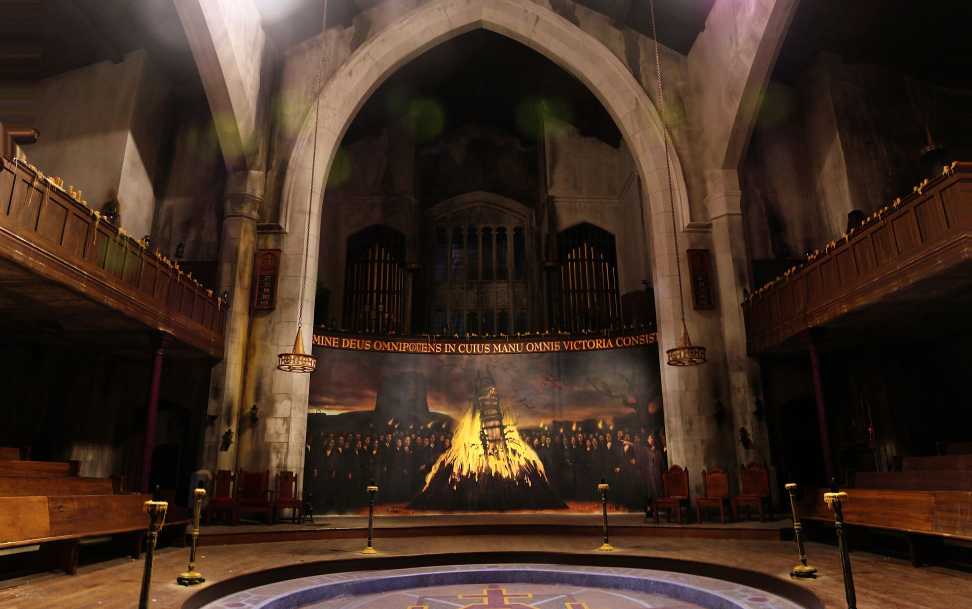
This image shows the inside of the church and how elements of mise-en-scene reinforce the religious themes.
How does the film
reflect its institutional or historical context? Analyse two scenes/events that
reflect the time which the film was made.
In the year 2006 more religious topics were reaching the
mainstream news. For example, 2006 saw a rise in paganism and experiments in
wicca/witchcraft mainly in America. In addition to this, feminists and gay
rights activists were fighting against the prejudice behind the church. At this
time, the dominant religion in America was Christianity and stories started to
unfold regarding the hypocrisy of their teachings. For example, many cases of child molesting had
been brought to people’s attention to demonstrate the contradiction between
what the bible teaches, and what Christians and Catholics do. Silent Hill
captures the zeitgeist by making references to both witchcraft and religion;
for example, Alessa’s mother is against the dominant religion and chooses to
follow the darkness and evil spirits. Similarly, references are made to
witchcraft as the audience witness Alessa being victimised for not having a
father and is burned for being a witch. The ending also sees Rose side with
evil in order to overrule the old-fashioned and hypocritical beliefs and
teachings of the powerful religious figures of that time. The film’s ability to incorporate a sense of
anti-establishment and a reflection on traditional teachings works in
conjunction with the movement in culture that brought a new age of consumerism
and dominant media companies. In addition to this, 2006 was the year that saw a
39% rise in the amount of child abductions. With this fear already in the minds
of the audience, Silent Hill added to the increasing concern by opening the
film with two desperate parents in search of their daughter, Sharon. Similarly,
the use of body horror involving a young girl being burnt alive clearly
demonstrates the time in which it was made. For example, the CGI gore effects
used shows how relaxed censorship has become as Silent Hill is only rated 15;
this makes it more apparent that the film is very modern and contemporary as it
demonstrates how films have adapted to shock audiences further.

No comments:
Post a Comment